
Blog overview:
- UK number plates follow a simple format: the first two letters show where the car was first registered (the DVLA “memory tag”), the two numbers show when it was registered, and the last three letters are random.
- New UK plate codes are released twice a year: 1 March (spring/summer) and 1 September (autumn/winter).
- Number plates can feature an optional coloured strip, including a green flash for zero-emission cars. A blue strip indicates the car was registered within the EU, and is no longer included on new plates.
- A private (personalised) number plate lets you use a specific registration. You can usually transfer or retain it, as long as you follow the DVLA rules.
Ever wondered what number plate characters mean? You're not alone. The British number plate system can cause confusion, with a range of number plate characters holding different connotations.
UK number plates aren’t random, they’re designed to tell you where a car was first registered and roughly when it was registered, which is handy when you’re getting a new car, checking a listing, or just being nosy.
In this blog, we’ll break down the UK registration plate format, explain what the colours/strips mean, and let you know when new plates are released.
Want the latest reg on your next car? Check out our latest lease deals.
Across England, Wales and Scotland, the current number plate system has been around for a few decades, but it's seen multiple changes compared to vehicles that existed before 2001.
Modern UK number plates follow this format:
AB22 ABC
- AB = where the car was first registered, also known as its DVLA memory tag.
- 22 = when it was registered
- ABC = random letters
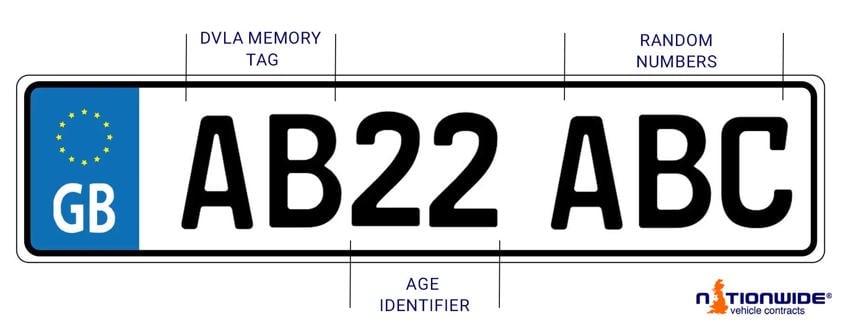
The first two letters are the DVLA memory tag. Put into plain English, this points to the region where the vehicle was first registered.
Some very broad examples:
- BA or BY often relates to cars registered in Birmingham or nearby
- Welsh cars often start with a C (for Cymru)
- Scottish cars often start with an S
The two digits in the middle tell you when the car was registered, and they change twice a year.
New plates are released twice yearly:
- 1st March (the new year plate for spring/summer)
- 1st September (the plate for autumn/winter)
The final three letters are random, and certain combinations are held back if they’re considered offensive.
So no, your plate ending in “KFC” doesn’t mean the car was built in a fried chicken factory. Sorry!
New plates are released twice yearly:
- 1 March (the “new year” plate for spring/summer)
- 1 September (the “+50” plate for autumn/winter)
Registration period (UK) | Plate code examples |
|---|---|
March 2025 - Aug 2025 | 25 |
Sept 2025 - Feb 2026 | 75 |
March 2026 - Aug 2026 | 26 |
Sept 2026 - Feb 2027 | 76 |
March 2027 - Aug 2027 | 27 |
Sept 2027 - Feb 2028 | 77 |
March 2028 - Aug 2028 | 28 |
Sept 2028 - Feb 2029 | 78 |
Outside of the characters, you can read a number plate via the vertical strips on the left side of the number plate. These can mean different things depending on their colour:
Before Britain left the European Union, cars often had a blue flash down the left side of the plate, usually filled with the EU logo with the letters ‘GB’ underneath.
Since Brexit, these are now no longer available on newer cars, but still perfectly legal.
Green flashes indicate an electric vehicle, allowing authorities to easily identify cars that are electric.
These aren’t compulsory, but they can help with cheaper parking, exemptions from clean air zone taxes, and can even offer the use of specific driving lanes.
A private (personalised) number plate is when you buy the right to use a specific registration number (rather than the one originally assigned to the vehicle).
You can transfer or retain a private plate, but there are rules around entitlement and paperwork.
If you’re leasing, private plates are often possible, but there’s a process to follow. If you'd like more information, we cover this in our guide: How to put private registration plates on a lease car
If you spot plates with weird spacing, fancy fonts, or bolt mods to change letters/numbers… that’s not just cringey, it can be illegal.
DVLA guidance warns you cannot rearrange or misrepresent letters/numbers to form names or words that are hard to read, and you could be fined up to £1,000 and fail an MOT if plates are incorrectly displayed.
Also, certain letters aren’t used in the memory-tag area, such as Z and Q, and you shouldn't see them on a legitimate UK number plate.
Looking for a new car with the latest plates? Leasing lets you drive a new car without the long-term ownership stress, handy if you're looking for a car with predictable month-to-month payments.
Want a hand picking your next car? Get in touch with our helpful team of experts on 0345 811 9595, or browse our latest lease deals.
Originally posted: 20th January 2026
Due to be reviewed: 20th January 2027