


Air pollution is now one of the UK’s most severe environmental health risks, leading to cardiovascular disease, respiratory illness, and lung cancer.
As congestion rises and pollution intensifies in many UK cities, we wanted to explore what the human body might look like after decades of exposure to traffic pollution. As one of the UK’s leading vehicle leasing brokers, we understand our responsibility to help drivers transition to cleaner, low-emission cars.
That’s why we’ve created Tim, the Toxic Air Survivor - a future human model based on real scientific evidence showing how UK city pollution is affecting us and what could happen if nothing changes.
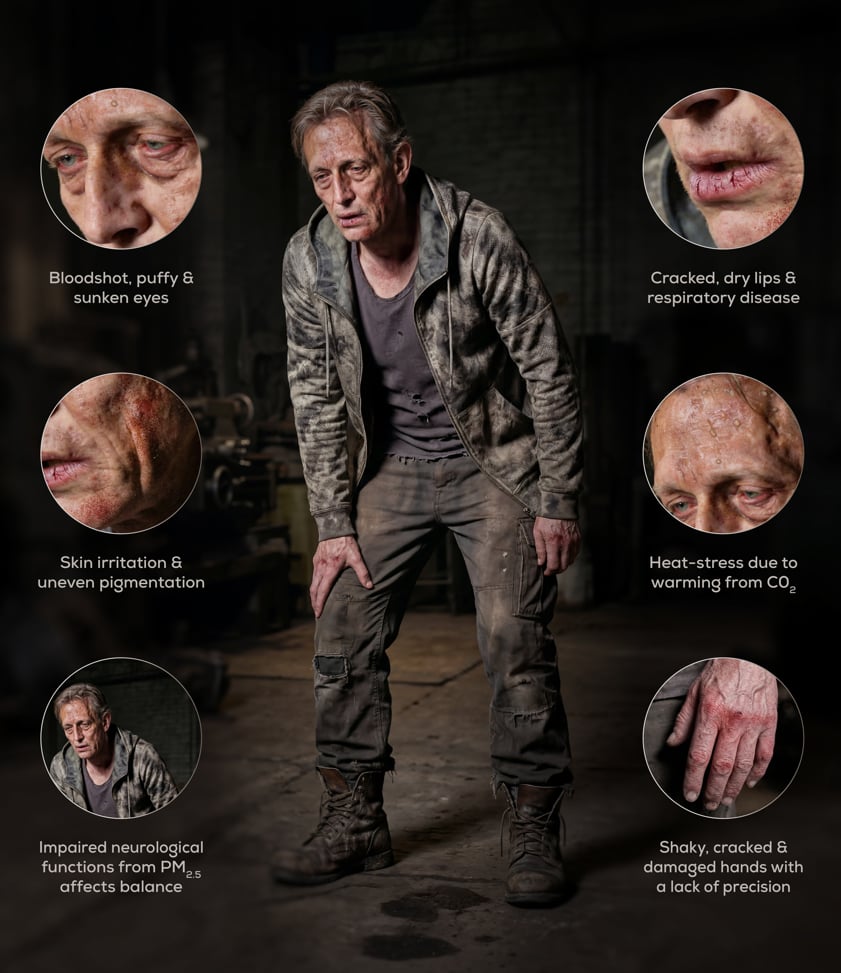
The face is often the first part of the body to betray what’s happening deeper within. Decades of exposure to traffic-derived pollution and diesel exhaust fumes disrupt the immune system and trigger continuous oxidative stress.
Over time, this constant biological pressure begins to reshape the human face in subtle but telling ways. Tim’s complexion appears muted; the natural brightness drained to a grey or sallow undertone. This is a visible sign of skin cells struggling to repair themselves under the strain of pollutant-induced inflammation.

Puffiness gathers beneath the eyes as the immune system remains constantly activated, leaving the skin swollen and tired-looking. Redness across the cheeks and jawline hints at repeated flare-ups, similar to eczema irritation, now common among those who live near congested roads. Even the lips appear cracked and dehydrated, reflecting how pollution speeds up moisture loss at the skin’s barrier.
With the UK government confirming that long-term exposure contributes to respiratory and cardiovascular disease and increases hospital admissions, these disruptions in internal health become increasingly visible on the surface.
Your eyes are directly exposed to whatever lingers in the air, and in many UK cities, that includes nitrogen dioxide, ozone, and ultrafine particulate matter.
For Tim, the eyes tell a story of constant irritation, from slightly reddened whites and subtly inflamed lids to an overall heavy, fatigued appearance. These changes echo the broader impact of traffic-related pollution on the body. WWF reports that the same pollutants which irritate the eyes also worsen chronic lung conditions, while government data identifies a clear link between air quality and respiratory hospital admissions.
Over time, with every blink drawing microscopic particles across delicate tissues, the eyes adapt to a state of low-level inflammation and a future where simple clarity becomes harder to maintain. The Toxic Air Survivor’s eyes reflect not just local irritation, but the shared strain of a respiratory system constantly under pressure.
While ageing is a natural process, polluted air accelerates it. Diesel exhaust fumes are known to trigger oxidative stress that overwhelms the skin’s antioxidant defences. Over several years, this oxidative burden damages collagen, speeds up dehydration, and leads to fine lines forming earlier than they normally would.
For the Toxic Air Survivor, ageing becomes increasingly visible as a rougher, uneven surface; a skin texture shaped not just by time, but by an environment that relentlessly attacks cellular integrity. Uneven pigmentation forms in patches, each marking a point where inflammation has disrupted the skin’s natural renewal cycle. In the same way pollution contributes to chronic respiratory and cardiovascular diseases, it also steadily erodes the skin’s resilience. The result is a complexion that looks as stressed as the body beneath it.

In polluted cities, every breath carries an invisible strain. Long-term exposure to vehicle emissions increases the risk of cardiovascular disease, respiratory disease, asthma flare-ups and even lung cancer. WWF further highlights how toxic air worsens existing illnesses and contributes to thousands of early deaths each year.
Breathing becomes a visible labour. The mouth hangs slightly open, compensating for reduced airway performance, and tension gathers across the upper chest and shoulders as the respiratory system works harder to take in oxygen. Years of inhaling PM2.5, nitrogen dioxide and diesel particulates reshape the body’s posture and the mechanics of breath itself.
In cities where poor air quality is the norm, the simple act of inhaling becomes a physiological challenge the body must constantly fight against.
Of all the changes endured by the Toxic Air Survivor, the shift in posture is perhaps the most unsettling - because it originates in the brain. PM2.5 particles are so small they bypass the body’s filters, travelling from lungs to bloodstream to neural tissue. Strong evidence shows that breathing PM2.5 impairs neurological functions and increases the risk of Alzheimer’s disease. Asthma + Lung UK also links long-term exposure to increased risk of dementia and type 2 diabetes, both conditions influenced by neurological health.
Traffic-derived ultrafine particles have shown genotoxic effects, meaning they can damage DNA and interfere with normal cell function. This disruption cascades through the motor system, presenting as balance issues, slowed reflexes and reduced coordination. Over the years, these effects alter how the body carries itself. The Toxic Air Survivor leans slightly forward, their posture subtly uneven, as weakened stabilising muscles and impaired neural signalling make upright balance more difficult to maintain.
The hands are a surprisingly sensitive indicator of neurological strain. While pollution doesn’t target the hands directly, the nerves and muscles controlling them depend on the brain’s precision.
The Toxic Air Survivor’s hands show faint tremors and a loss of precision, almost imperceptible at first glance, but unmistakable upon closer inspection. The knuckles appear dry and slightly reddened, reflecting a body under chronic inflammatory pressure. As pollution chips away at neural efficiency and muscular integrity, the hands reveal the small but consequential erosion of fine motor control.
Hair may seem superficial, but it is one of the first tissues to suffer when the body is dehydrated or stressed. Cars act as radiatively active surfaces, raising temperatures in already congested city streets, which places the body into a near-constant state of heat stress.
This shows up as dull, dry and brittle hair, a direct result of chronic dehydration and environmental exposure. When the body is forced to prioritise cooling, oxygenation, and immune response, hair health simply becomes non-essential. Over the decades, this leads to strands that frizz, break, and lose natural shine.

One of the most visually striking transformations is how the Toxic Air Survivor handles heat. In polluted cities, vehicles don’t just emit particulates; they radiate warmth. Research shows that cars contribute to localised heating, intensifying the urban heat island effect.
The result is a body constantly battling to stay cool. Cheeks and upper chest flush as blood rushes to the skin’s surface. A fine sheen of sweat appears across the forehead and neck; not from exercise, but from the effort of thermoregulation. The eyes appear slightly sunken, reflecting chronic dehydration. Dry lips and dull skin are tell‑tale signs that the body is losing moisture faster than it can retain it.
In this future, heat stress isn’t an occasional summer hazard; it’s a daily environmental pressure reshaping the human form.
Based on congestion, vehicle ownership, emissions and EV uptake, we have highlighted several high-risk UK cities:
- Edinburgh
- Bristol
- Cardiff
- Hull
- Southampton
Large urban centres like London, Manchester and Birmingham also face significant long-term risk due to traffic density and population exposure.
At Nationwide Vehicle Contracts, we’re committed to helping protect drivers, families and communities. Here’s what we recommend for greener driving:
- Choose a cleaner vehicle - Leasing an electric or hybrid vehicle significantly reduces personal and community exposure.
- Avoid peak pollution times - Rush hours carry higher concentrations of pollutants.
- Improve in-car air quality - A good cabin filter can reduce particulate exposure significantly.
- Select cleaner routes - Even one street away from major roads makes a measurable difference.
- Support clean air zones - EV adoption, low-emission zones and clean air policies are proven to improve city scores.
By driving cleaner, you can help the planet while improving your health.
Cleaner transport is one of the most impactful and immediate solutions to reducing emissions and improving air quality. Key actions include:
- Switching to EVs or fuel-efficient cars
- Reducing short car trips
- Car-sharing
- Supporting clean air zones
- Keeping vehicles properly maintained
Higher EV ownership correlates strongly with better index scores across UK cities.
- https://www.gov.uk/government/publications/health-matters-air-pollution/health-matters-air-pollution
- https://www.wwf.org.uk/articles/impact-car-use-air-quality
- https://www.ucs.org/resources/vehicles-air-pollution-human-health
- https://www.asthmaandlung.org.uk/support-us/campaign-with-us/clean-air-campaigns/what-effect-does-air-pollution-have-your-health
- https://cordis.europa.eu/article/id/449946-linking-vehicle-emissions-to-brain-health
- https://www.mdpi.com/2813-3137/3/2/14
- https://link.springer.com/article/10.1007/s44274-026-00593-8
- All images designed by Ben Smith, Make-Hay
Originally posted: 2nd April 2026