Electric Car Batteries Explained: How They Work & How Long They Last
 By Alex
Guide overview:
- An electric car battery is a large rechargeable pack that powers the entire car. It's completely different from the battery in petrol and diesel cars, which just starts the engine.
- EV batteries store energy when you plug in, release it as you drive, and recover it through regenerative braking when you slow down.
- Capacity is measured in kWh. Expect around 80% of the quoted range in real-world driving.
- Modern EV batteries lose just 2.3% capacity per year and typically outlast the car, with warranties covering eight years or 100,000 miles.
If you’re considering an electric vehicle for the first time, you’ve probably got a few questions about EV batteries. How long do they last? What does kWh actually mean? Will it cost a fortune if something goes wrong?
The good news is you don't need an engineering degree to understand how EV batteries work. In this guide, we'll explain how electric car batteries work, what the jargon means, how long they really last, and why, if you lease, most of the worries disappear entirely.
Straightforward pricing, from an independent broker. Nationwide Vehicle Contracts is one of the UK's largest electric car leasing brokers, helping you to find the right EV at the right price. Browse our latest electric car lease deals.
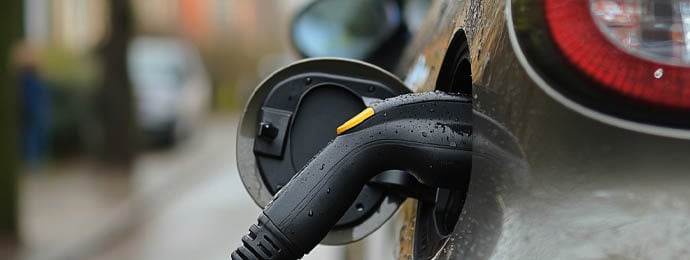
Put simply, an electric vehicle (EV) battery is a specialised power unit that stores and supplies the electricity your car runs on. Where a petrol car burns fuel from a tank, an EV draws electricity from its battery to power the motor, run the heating, and power everything else on board.
They are very different from the small battery in petrol and diesel cars, which is used to start the engine and keep the electrics ticking over. An EV's main battery does all the heavy lifting, which is why it's so much larger and sits under the floor of the car.
The key characteristics of an EV battery:
- High energy density - Storing enough energy in a compact pack to cover hundreds of miles between charges.
- Steady power delivery - Feeding the motor smoothly, whether you're crawling through town or overtaking on the motorway.
- Thermal management - Built-in heating and cooling that keeps the battery at its optimal temperature, protecting performance and lifespan.
- Longevity - Engineered to handle thousands of charge cycles, so the battery typically outlasts the car itself.
Breaking it down to its simplest form, an EV battery works in three phases:
- Charging - When you plug in, electricity flows into the battery and is stored through a chemical reaction inside its cells.
- Discharging - When you drive, that stored energy is released as electric current to power the motor.
- Regenerative braking - When you slow down, the motor runs in reverse and acts as a generator, feeding energy back into the battery instead of wasting it as heat. It's why EVs are so efficient in stop-start traffic.
Managing all of this is the battery management system (BMS), the battery's built-in brain. It balances the individual cells, controls temperature, and protects the pack from overcharging or running too low.
You'll never interact with the BMS directly, but it quietly goes about its work to protect the battery.
Nearly every electric car on sale today uses a lithium-ion battery, the same tech used in your phone or laptop, albeit scaled up and toughened for cars.
Some EVs, including many by MG, BYD and standard-range Tesla models, use a type of lithium-ion battery called LFP. These are cheaper to make and exceptionally durable, and unlike other batteries, they're perfectly happy being charged to 100% every day.
Longer-range models tend to use batteries that pack more energy in per kilo, but prefer everyday charging to around 80%. Your car's handbook will tell you which you have.
You may also have heard about solid-state batteries, which promise longer range and faster charging. They're coming, but not yet. The first production cars are expected around 2027-28, so keep your eyes peeled.
If you’re a bit of a novice, all those letters have probably terrified you. Let's simplify it for you:
- BEV = battery electric vehicle
- PHEV = plug-in hybrid
- HEV = hybrid
- MHEV = mild-hybrid
Vehicle Type | Battery Size | Battery Role | Charging Required | Electric-only Range |
|---|---|---|---|---|
BEV | Large (40-100kWh+) | Powers everything | Yes | Long (150 to 350+ miles) |
PHEV | Medium (10-35kWh) | Handles shorter trips, assists the engine | Yes (to maximise the benefits) | Short (25 to 70 miles) |
HEV | Small (1-2kWh) | Assists the engine | No | Minimal (less than 2 miles) |
MHEV | Very small (under 1kWh) | Boosts engine efficiency & reduces emissions | No | None |
Battery capacity is measured in kilowatt-hours (kWh). The easiest way to think of it is as the size of a fuel tank. A 40kWh battery holds half the energy of an 80kWh battery, so all else being equal, it'll take you about half as far.
As a rough guide to what's on the UK market:
- Around 40 to 52kWh - Small city cars and superminis like the Renault 5, typically offering 190 to 250 miles of official range.
- Around 60 to 80kWh - Family hatchbacks and mid-size SUVs, where 250 to 350 miles of official range is now the norm.
- Around 90 to 100kWh+ - Large SUVs and luxury cars, where big batteries support seven seats, towing, and 300-plus-mile ranges.
For more information on kWh, check out our guide: Understanding miles per kWh
One of the biggest complaints we see when customers lease an EV for the first time is that their EV isn't returning anywhere near its quoted range.
This is because manufacturers quote a WLTP range, which is the result of a standardised lab test and not real-world driving conditions.
A sensible rule of thumb is to expect around 80% of the WLTP figure on a good day. Cold weather, motorway driving, a fully loaded boot and the heating running will all nibble away at range, so a car quoted at 250 miles is realistically a 200-mile car when on the road.
It's tempting to go for the biggest battery around, but bigger doesn't always mean better. A bigger battery costs more, weighs more, and takes longer to charge.
The average UK driver covers under 30 miles a day, comfortably inside the range of some of the smallest EV batteries on sale.
Match the battery to your actual mileage, not your worst-case scenario, and you'll often save a meaningful amount on your monthly payment and EV running costs.
“When choosing an EV, it's crucial to balance battery capacity with your driving needs. A larger battery isn’t always better; consider your daily mileage and charging access first.”

A common misconception regarding EV batteries is that they rapidly deteriorate. That is simply not the case.
All batteries gradually lose a little capacity over time. It's called degradation and it's a slow fade, not a sudden drop-off. For example, a battery that once delivered 250 miles might deliver a range around the 200 mark after several years.
A study by Geotab, tacking more than 22,700 electric vehicles, found modern EV batteries lose an average of just 2.3% capacity per year. At that rate, the average battery still holds over 80% of its original capacity after eight years!
It also found that EVs operating in hot climates deteriorate 0.4% faster than those in mild climates, something you don't have to worry about in the UK!
A few habits to keep degradation to a minimum:
- Stay in the 20 to 80% zone for everyday charging. Charging to full is fine for a long trip, just don't leave the car sitting at 100% for days.
- Don't rely on rapid charging for everything. Regular high-power rapid charging is the single biggest accelerator of battery wear. The same study found heavy rapid-charger users degrading at up to 3% per year. Slower home or workplace charging is kinder for daily top-ups.
- Avoid running the battery right down regularly. Occasional low charge is fine; living at 5% isn't.
Every EV battery comes with a dedicated battery warranty, which is separate from and often much longer than the standard vehicle warranty.
The industry norm is eight years or 100,000 miles, whichever comes first, and most guarantee the battery will retain at least 70% of its original capacity in that time. Some manufacturers go further still, with brands like Lexus offering to cover for up to ten years with annual battery health checks.
If you're planning on leasing an EV, things like degradation, replacement costs and long-term battery health don't matter as much as if you were buying.
A typical lease runs for two, three or four years. The battery warranty runs for eight years or 100,000 miles, so your contract will always end long before the warranty does, so if anything were to ever go wrong with the battery, you should be covered.
And degradation? At 2.3% per year, a battery on a three-year lease loses around 7% of its capacity by the time you hand the car back, a difference you'd struggle to notice.
Not sure which electric car to go for? Our UK-based team has been helping drivers find the right car since 2002, with over 180,000 contracts arranged. Call us today on 0345 811 9595 to get expert guidance.
Three easy habits will keep yours performing at its best:
- Precondition before you drive. Warming or cooling the cabin while the car is still plugged in uses mains power rather than battery, protecting your range. Most EVs let you schedule this from an app.
- Mix your charging. Use home or workplace charging for everyday top-ups and save rapid charging for longer journeys.
- Drive smoothly. Gentle acceleration and early, light braking let regenerative braking recover more energy. You'll see the difference in your range.
Charging speeds themselves, from a three-pin plug to 350kW ultra-rapid units, are a topic of their own. Our guide EV Charging Explained covers every charger type, connector and speed in detail.
Most modern EV batteries are expected to last 15 to 20 years, longer than the average car stays on the road.
Real-world data from over 22,700 EVs shows average capacity loss of just 2.3% per year, meaning a typical battery still holds more than 80% of its capacity after eight years of driving.
Nationwide Vehicle Contracts is one of the UK's largest independent leasing brokers, trusted since 2002 with more than 180,000 leases arranged. For more advice on going electric, explore our full library of Electric and Hybrid Car Guides or browse our latest electric lease deals to see what your next car could cost.
Guide Information
Originally published: 22nd October 2024
Last updated: 21st July 2026

You may also like...