
Is an Electric Van Worth It? Costs, Range & Benefits
 By Alex
Guide overview:
- Electric vans can be worth it if your daily mileage is predictable, you have reliable access to charging, and the van can handle your usual payload.
- Running costs can be lower than diesel, especially if you charge at home or work, although public rapid charging can reduce those savings.
- Range and capability still matter, so check real-world range, payload, towing capacity, and charging needs before making the switch.
If your business relies on a van day-to-day, an electric van can be worth considering, particularly if your mileage is predictable and you have reliable access to charging.
Electric vans can cost less to run than diesel models, especially if they're regularly charged at home or work, although public rapid charging can reduce those savings.
Range has improved considerably in the last few years, but real-world range still depends on factors such as payload, temperature, driving speed, and how you use the van.
Payload and towing capability also vary by model, so it's important to choose an electric van that can handle your normal workload.
In this guide, we'll explain the advantages and disadvantages of electric vans, what they cost to run, how far they can travel, and how to decide whether one will work for your business.
Thinking about making the switch to electric? As an independent leasing broker, we offer straightforward pricing across a wide range of electric vans, helping you compare your options without the hassle. Browse our latest electric van lease deals.
Electric vans can offer lower running costs, reduced maintenance requirements, and zero tailpipe emissions, making them a strong option for many businesses.
Benefits include:
- Lower running costs if you can regularly charge your van at home or work.
- Potentially lower servicing and maintenance costs thanks to an electric drivetrain having fewer moving parts than a combustion engine.
- Zero tailpipe emissions, making electric vans particularly well suited to businesses operating in towns and cities.
- A quieter and smoother driving experience, which can make long days behind the wheel that bit more comfortable.
- Tax and incentive benefits. For the 2026/27 tax year, zero-emission vans have a 0% van benefit charge if they're available for private use. Some eligible electric vans can also benefit from a government discount.
- The ability to drive in emission-based zones without the charges that can apply to some older petrol and diesel vans.
If you're considering switching several vehicles rather than just one, our electric fleet leasing guide explains what businesses need to consider when electrifying their fleet.
The main drawbacks of electric vans are range, charging requirements, and potential compromises in payload or towing capability.
Before making the switch, consider:
- Higher cost on some models compared with equivalent petrol or diesel vans.
- Shorter driving ranges than many diesel vans, which can make long or unpredictable working days more difficult.
- Charging downtime if you regularly need to recharge while working.
- Higher public charging costs if you can't charge at home or work regularly.
- Potential payload or towing compromises for some electric vans due to the additional weight of the battery.
- More journey planning when you're travelling beyond the van's comfortable daily range.
Consideration | An electric van may suit you if... |
|---|---|
Daily mileage | Your typical working day comfortably fits within the van's real-world range |
Charging | You can regularly charge at home, work, or somewhere convenient |
Payload & towing | The van can carry your usual tools and equipment, and it's towing capacity meets your requirements |
Long journeys | You can accommodate charging stops when they're needed |
Electric vans can cost less to run than diesel vans, particularly when they're charged at home or work.
Your overall running costs will depend on several things:
- Electricity - Your tariff and where you charge have a big impact on costs.
- Monthly lease payment - Some electric vans have a higher monthly cost than their diesel equivalents.
- Servicing and maintenance - Electric drivetrains have fewer moving parts, which can reduce long-term maintenance requirements.
- Insurance - Premiums vary by vehicle, business and driver.
- Tax - Current tax rules may favour zero-emission vans in certain circumstances.
Under the right circumstances, yes. If you can regularly charge at home or work, then the cost per mile can be lower than filling up a diesel van.
A business that covers regular mileage and charges predominantly at home or on its premises is likely to make a stronger financial case for electric vehicles than one that relies on public rapid chargers every day.
Maintenance can also work in an electric van's favour because there's no engine oil, exhaust system, or clutch to worry about.
The best approach is to compare the complete monthly cost of the electric and diesel vans you're considering rather than assuming one fuel type will automatically be cheaper.
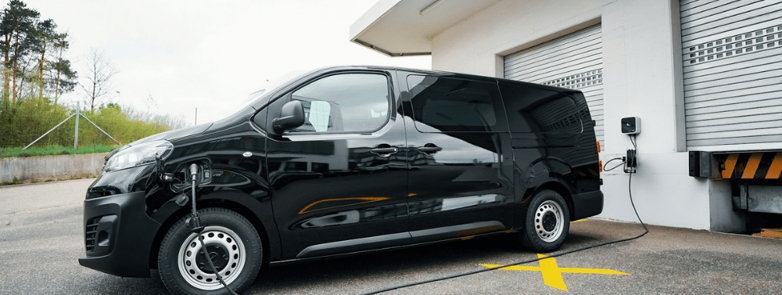
The cost of charging an electric van depends mainly on its battery size, how much energy you're adding, and the price you pay per kilowatt-hour (kWh).
For example, if your electric van has an 80kWh battery and you're paying 25p per kWh, a theoretical charge from empty to full would cost around £20.
In reality, you'll rarely charge from completely empty to 100%, so your actual costs will vary.
Where you charge also matters:
- Home charging - Can be one of the cheapest options with an off-peak tariff.
- Workplace charging - Allows your business to recharge an electric van when it's not in use.
- Public charging - Useful when you're away from base but usually costs more.
- Rapid charging - Can get you back on the road quickly, but it comes at a premium.
An electric van can still be worth it without home or workplace charging, but relying on the public network can make it less convenient and likely more expensive.
You'll need to consider the chargers in your area or around your usual routes, and work out how charging could fit into your working day. If you regularly park near a reliable charger while you're working, for example, going electric could still make sense.
Not sure a new van is the right fit for your business just yet? A used van could be a more practical option, giving you access to a reliable working vehicle at a lower monthly cost. Explore our used van lease deals.
Many electric vans offer an official WLTP range of roughly 150 to 250 miles, though some can travel further. The distance you achieve in everyday driving will depend on how the van is used.
Several factors influence an electric van's range, including:
- Payload and passengers
- Outside temperature
- Driving speed
- Driving style
- Terrain
For example, an electric van with an official range of 200 miles might comfortably cover your normal working day. But loading it with your team, tools, and materials before spending several hours on the motorway will reduce your range.
Electric vans can cover longer journeys, but you'll need to plan ahead more if you regularly drive on the motorway.
If you're travelling beyond the van's comfortable range, charging speed becomes particularly important. A van that can quickly add useful mileage during a planned break may be better suited to long-distance work than one with a slightly longer range but significantly slower charging.
Businesses covering local or predictable routes should generally find range easier to manage.

Electric vans can offer competitive payloads and load space, sometimes on par with diesel vans, but battery weight means capability varies significantly between models.
Batteries are heavy pieces of kit, and that extra weight can reduce the load some vans can carry compared with their diesel equivalents. This can be particularly important on larger vans where businesses regularly carry heavy tools, materials, or goods.
Driving licence rules help offset some of this. In Great Britain, Category B licence holders can drive a zero-emission vehicle with a maximum authorised mass of up to 4,250kg, compared with the usual 3,500kg maximum for petrol and diesel vehicles.
Electric vans can also tow, although again, capacity varies significantly between models.
Before choosing your electric van, check:
- Maximum payload
- Load volume and dimensions
- Towing capacity
- Gross vehicle weight
- Real-world range
Not sure which electric van will suit your business? Our UK-based team can help you find the right van for the way you operate. Explore electric van leasing today.
Whether you're driving a car or a van, switching to electric is worth it for the right driver, or in this case, the right business.
If your daily mileage is predictable, you have reliable, consistent access to charging, and the van you choose can handle your usual payload, then switching to an electric van could be a great option. You'll benefit from a smooth driving experience and could also reduce some of your day-to-day running costs.
On the other hand, if you regularly cover long and unpredictable distances, rely heavily on public charging, or need maximum payload and towing capability, you'll need to consider your options more carefully.
Before making the switch, ask yourself these questions:
- Can I charge conveniently without disrupting my working day?
- Will the van comfortably cover my usual daily mileage?
- Can it carry and tow everything my business needs?
- Do the overall costs make sense compared to my current van?
If the answer to all four is yes, there's a good chance an electric van could work for your business.
We've been helping drivers and businesses lease their next vehicle since 2002, with more than 180,000 lease agreements arranged. If you're ready to make the switch, take a look at our latest electric van deals. Browse our latest electric van lease deals.
Guide Information
Originally published: 25th August 2026
Last updated: 22nd September 2026

You may also like...